Dhanashree Bhagwatkar

Greenworks operates at the intersection of
high-consideration commerce, hardware complexity,
and lifecycle ownership. Customers must navigate tool compatibility, battery systems, property-specific needs, and post-purchase management, all within a fragmented ecosystem of experiences.
As the platform scaled, experience inconsistency, decision friction, and system-level gaps began to impact conversion, retention, and operational efficiency directly.

1000+
Patents Published
500+
Product Catalogue
4
Business Verticals
10+
Countries Globally
Key Case Studies


#3 AI: My Garage
Decision Support Through Personalization
Created a personalized, signal-driven recommendation flow that adapts to user context and behavior to improve engagement and relevance across product discovery.
.png)
#4 Experience Overhaul
Designing Decisions, Not Just Pages
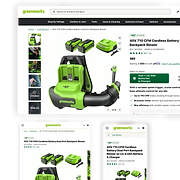
Redesigned PDP, PLP and Dashboard experiences to clarify comparison and buying decisions, driving higher conversion, AOV, and lower bounce.
.png)
Fragmented UX to Scalable Experience Strategy
How Greenworks’ Design System Enabled Platform Consistency and Speed
Tools
Figma | JIRA | Google Docs | Adobe Creative Cloud | GA4 | Shopify Analytics
Role
Lead UX Designer | Experience Strategy | UX Foundations
Deliverables
-
UX principles & decision frameworks
-
Experience architecture across discovery, purchase, ownership, and AI flows
-
UX operating practices
-
quality reviews, alignment rituals, insight synthesis
-
-
Measurement model connecting UX decisions to business outcomes
Impact
↑~30%
task completion across priority journeys
↑~45%
design-to-dev handoff efficiency
6+
Coversion and retention focused initiatives
My Role
At Greenworks, I operated at a platform and systems level, owning UX foundations, decision frameworks, and cross-team alignment across multiple commerce, systems, and lifecycle surfaces.
I partnered closely with Product, Engineering, Data, and Marketing to:
Set Experience Direction
Defined UX principles and decision frameworks across the end-to-end customer lifecycle.
Establish Scalable UX Foundations
Built design systems and patterns to enable consistency, reuse, and faster execution.
Drive Insight-Led Decisions
Ensured research and behavioral data informed prioritization and design trade-offs.
Lead Platform-Level Initiatives
Owned high-impact initiatives across commerce, lifecycle, and AI-assisted experiences.
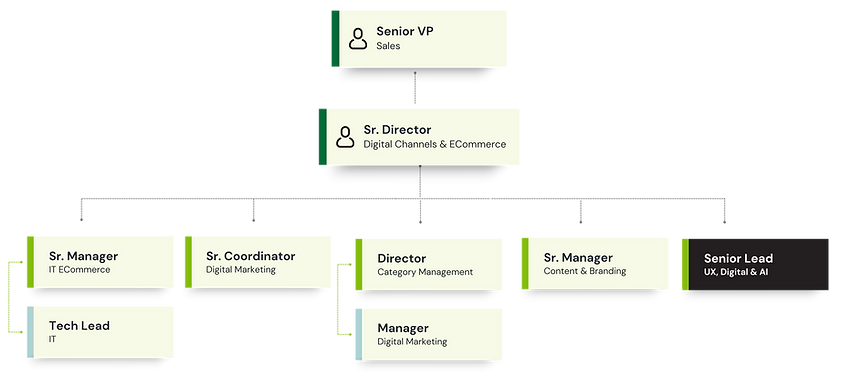
The Team
.png)
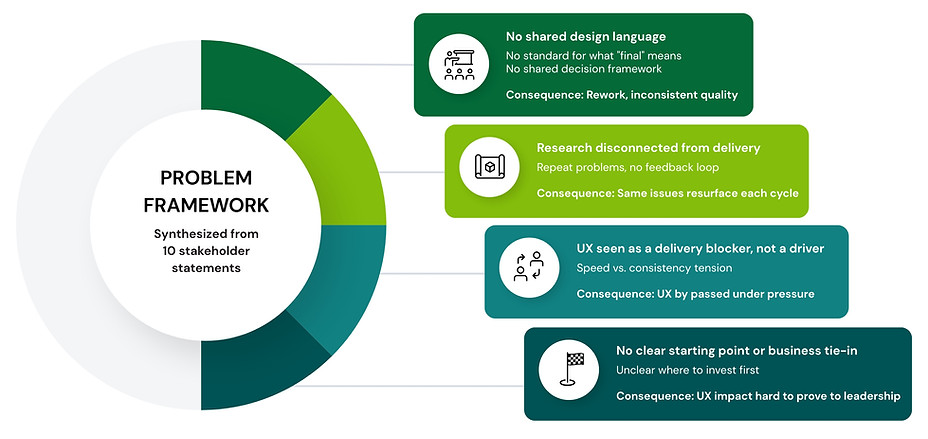
What I heard?
As I worked closely with different teams, similar frustrations surfaced, expressed differently, but rooted in the same gaps.
What I Realized
Teams wanted clarity:
The challenge wasn’t resistance to UX.
It was the absence of structure.
When should
UX be involved?
How do we make
decisions consistently?
UX needed to move from
helpful but optional to
predictable and trusted.
What does “good UX”
mean here?
How do we know
we’re improving?
Goals: Key KPI's
Conversion Rate
discovery
purchase
post-purchase journeys
Retention & Engagement
Platform velocity & scalability
stronger account ownership
lifecycle experiences
shared systems patterns
reusable components
Friction points across path
unifying flows and reducing cross-platform inconsistencies
Time to decision
faster discovery,
clearer decision-making, and streamlined actions
Support dependency
improving self-service flows and ownership tools
Instead of asking,
“What should I design?”
I started asking,
“What system would make a better design inevitable?”
The Shift
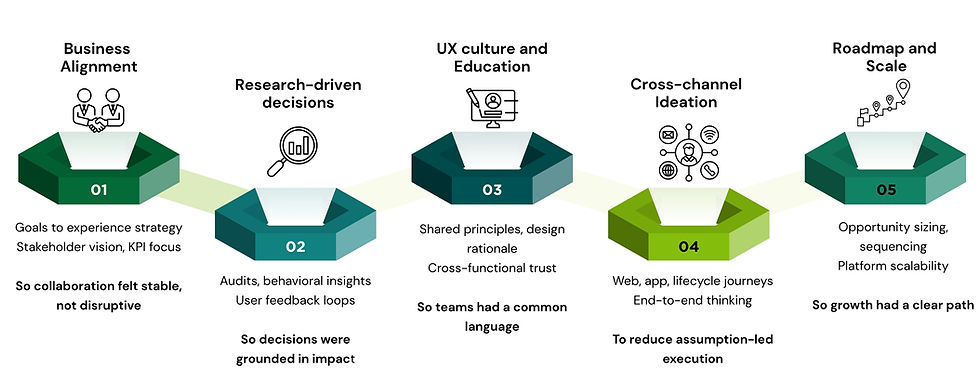
Building the Foundation
Business Alignment
In a fast-moving environment, decisions were often
made based on:
-
Past experience
-
Strong opinions
-
Time pressure
Even strong UX ideas stalled when they weren’t clearly tied to business outcomes.
I began reframing UX conversations away from features and toward:
Goals, Trade-offs, Impact
Ensuring that:
-
UX decisions mapped to business priorities
-
Stakeholders saw design as a strategic lever
-
Success could be discussed in terms of leadership that cared about
UX needed to speak the language of the business to earn influence.
Research-Driven Decisions
I repeatedly heard variations of:
-
“How does this help the business?”
-
“Is this worth prioritizing right now?”
This created inconsistency and repeated debates.
Instead of positioning research as a “phase,”
I treated it as decision support.
This supports:
-
Reduce opinion-led back-and-forth
-
Ground discussions in observable behavior
-
Create confidence when trade-offs were necessary
Research wasn’t about validation; it was about clarity.
UX Culture & Education
Early on, I noticed that most UX friction wasn’t about disagreement; it was about misunderstanding.
-
Engineers weren’t sure why certain UX decisions mattered
-
Stakeholders interpreted UX feedback as subjective
-
Designers had to re-explain the rationale repeatedly
This told me the issue wasn’t skill, it was shared context.
I realized UX needed to function as a shared language, not a specialized function.
This emerged to:
-
Create common principles that teams could reference
-
Make design rationale explicit and reusable
-
Build trust by demystifying UX decisions
UX couldn’t scale without shared understanding.
Cross-Channel Ideation
I noticed teams were solving problems in isolation:
-
Web decisions didn’t consider app implications
-
Purchase experiences didn’t connect to ownership
-
Lifecycle touchpoints were treated as afterthoughts
This fragmented the user experience.
I began stepping back and asking:
-
“Where does this experience start?”
-
“Where does it actually end?”
This helped:
-
Break channel silos
-
Encourage end-to-end journey thinking
-
Ensure experiences felt cohesive, not stitched together
Users don’t experience products in channels; they experience journeys.
Roadmap & Scale
Even when alignment existed, I saw good ideas fail because:
-
Everything felt equally important
-
Teams lacked sequencing
-
UX work reacted to roadmaps instead of shaping them
I started focusing less on what we should design and more on when and why.
This helped to:
-
Size opportunities realistically
-
Balance quick wins with foundational work
-
Ensure UX decisions aged well as the platform grew
Good UX at scale is as much about timing as it is about quality.
.jpg)
Making Structure Real: The UX Operating Rhythm

Where I Faced the Most Friction
01
Balancing short-term delivery pressure with long-term system thinking
02
Gaining alignment without formal authority
03
Proving value before metrics were mature
04
Introducing structure without slowing teams down
I addressed these by:
.png)
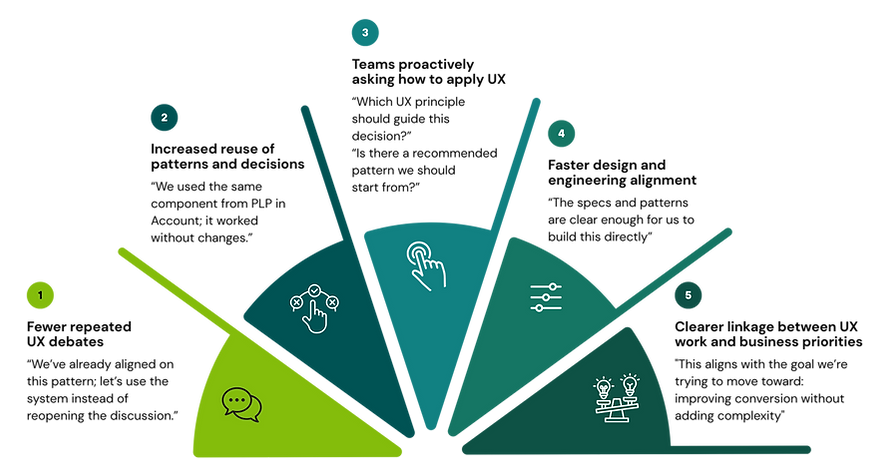
Measuring Progress
.png)